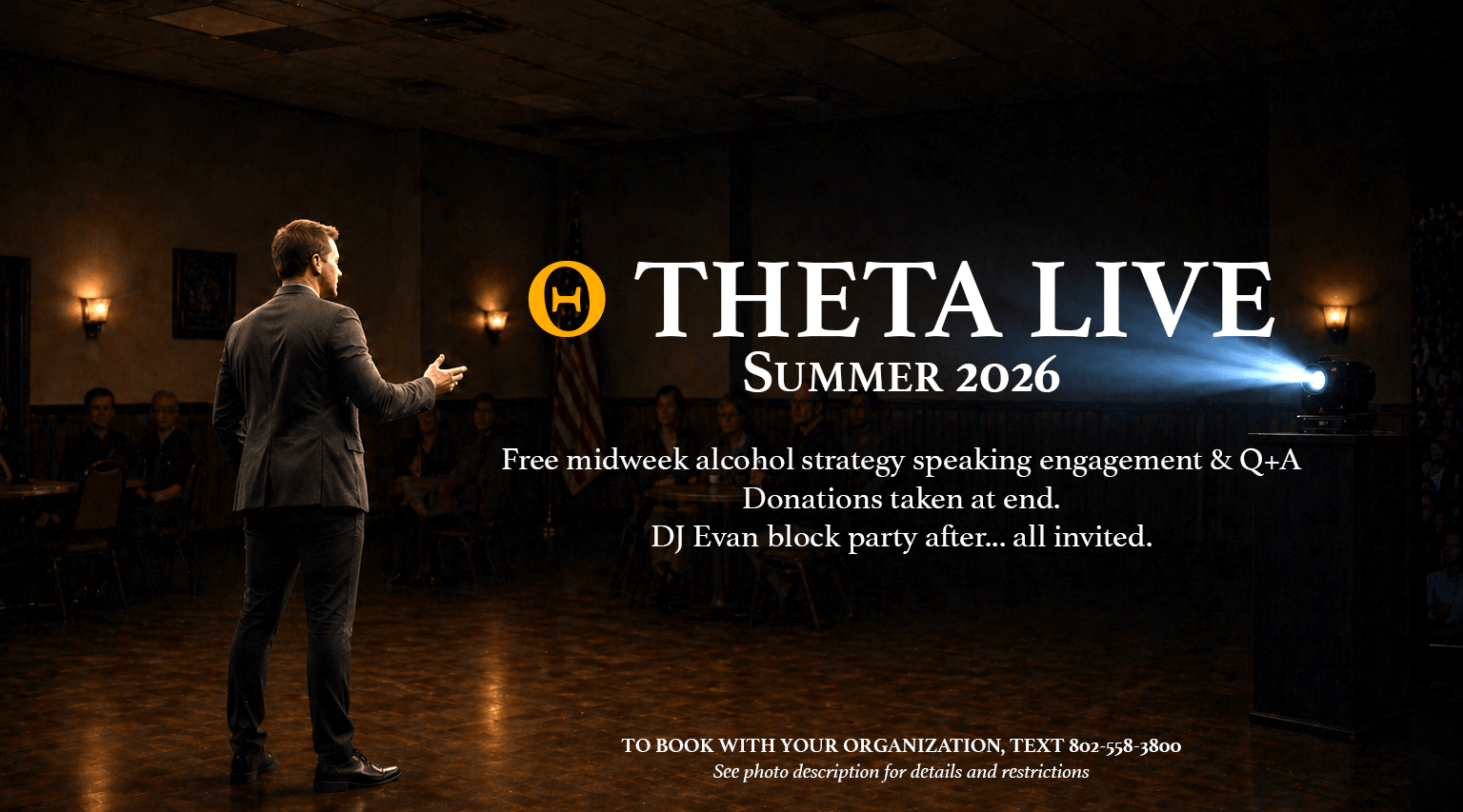
MIDWEEK SPEAKING ENGAGEMENTS (plus block party) — NOW BOOKING
I’m taking my project on the road across Vermont.
Many of you have seen me at celebrations over the past 20 years. What you may not know is that for 15 of those years, I struggled with alcohol—what started as a casual choice slowly became a dependency. Today, by definition, I’m still an alcoholic—but I have zero desire to drink.
That shift didn’t come from willpower alone. It came from confronting what I had accepted as “normal,” and identifying the part of myself that kept pulling me back. Most people want out—but they don’t know how to get out.
That’s where THETA comes in.
What started as a no-judgment Zoom room became a growing podcast with listeners from Vermont to Florida and British Columbia. Now, those core ideas have been shaped into a live presentation focused on real, practical strategies—not surface-level fixes or recycled dogma.
I grew up in Arlington, Vermont—just 20 minutes from where Bill Wilson (AA founder) lived. This presentation is about confronting environment, behavior, and reality—directly and honestly.
HOW TO BOOK A $0 SPEAKING ENGAGEMENT
I already travel throughout Vermont for my wedding business. If you reach out, I’ll coordinate a speaking engagement when I’m already scheduled to be in your area.
REQUIREMENTS
- Non-Saturday dates only
- Open environment (uncensored language acceptable — no slurs)
- No alcohol sales during the event
- Projection capability (screen + low lighting)
Not ideal: schools, churches, active bars/restaurants
Acceptable: private event spaces with bar closed and secured
IDEAL VENUES
- Event spaces (midweek availability)
- Conference rooms (workplaces or hotels)
- Fraternal organizations
- Municipal theaters
- Outdoor evening setups
- Recovery-focused gatherings
EMPTY ROOM POLICY
Organizers agree to promote the event using provided materials.
Attendees may donate via QR code at the end.
If attendance is 25 people or fewer:
- $100 minimum fee + travel (if applicable)
PREFER A GUARANTEED BOOKING?
- $750 — Presentation + DJ Family Dance
- $500 — DJ only
Rates may increase slightly based on travel distance.
FREQUENTLY ASKED QUESTIONS
What is THETA?
A framework for understanding and breaking behavioral loops using: acknowledge, mitigate, facilitate, and fight.
Is this only for people with alcohol problems?
No. It applies broadly to habits and behavioral patterns.
Is this like AA?
No. It’s more direct and framework-based, less traditional.
Is it workplace appropriate?
Yes—with candid language. A toned-down version can be discussed.
Length?
Typically 60–90 minutes.
Technical needs?
Open space, power within 50ft, low light preferred. Seating optional (BYOC).
Audience size?
30–150+ works best.
Travel?
Primarily Vermont; nearby regions considered.
After the presentation?
Optional Q&A, donations, and DJ block party.
Recorded?
Audio recorded during presentation for improvement. Q&A is not recorded.

The first step is to acknowledge that alcohol, embedded deeply in society, often cheats you out of genuine well-being, clarity, and opportunity. It has long been a substitute for real medical help, masking problems rather than addressing them, and leaving you short of the better path you deserve.

When we say mitigate, we mean taking that behavior and consciously redirecting it. Instead of letting alcohol fill a void or act as a crutch, you find healthier substitutes—whether it’s hobbies, mindfulness, supportive social connections, or healthier routines. It’s about taking that energy and placing it somewhere that builds you up rather than holding you back.

Facilitate means building a proactive relationship with your physician or support network. Instead of going it alone, you create a plan alongside those who can help. This collaboration ensures you have guidance, accountability, and a clear pathway to healthier changes.

Fight means committing to the path you’ve chosen, but here’s the twist: it’s not just about gritting your teeth. It’s about celebrating each small win along the way, knowing every step forward is reclaiming a piece of what you deserve. So you don’t just resist—you fight with purpose and celebrate the journey.
PAST EPISODES
Episode 6
This week’s Theta introduces the concept of externalization—separating your healthy, responsible self from the part of you that turns to alcohol as a coping tool. Instead of shame or self-criticism, the episode encourages listeners to “interview” their drinking self to understand the stress, anxiety, or unmet needs behind it and take back leadership over their choices. Framed around the Theta principles—Acknowledge, Mitigate, Facilitate, and Fight—the message is simple: addiction isn’t a moral failure, it’s a coping strategy that can be replaced through honest self-awareness, better support, and a committed path forward.
Episode 5
This week’s Theta explores “the devil in normal”—the idea that harmful habits, especially with alcohol, often hide inside routines we’ve come to accept without question. The episode challenges listeners to examine the “normals” in their lives and recognize that normal doesn’t always mean healthy, chosen, or permanent. Through personal stories and the Theta principles—Acknowledge, Mitigate, Facilitate, and Fight—the message is that real change begins when you question inherited routines, build better support, and consciously replace what once felt normal with what actually moves your life forward.
We half-assed this one. Will revisit this topic at a later date.
Episode 3
This week’s Theta examines the evolving role of cannabis in alcohol recovery, exploring how it can serve as a harm-reduction tool while also carrying its own risks if it becomes another dependency. Through personal experience and a candid guest conversation, the episode highlights the importance of addressing underlying medical or emotional issues, building strong support through therapy and healthcare, and staying aware of when a coping tool stops helping. Guided by the core principles—Acknowledge, Mitigate, Facilitate, and Fight—the message is that recovery isn’t about replacing one substance with another, but about pursuing clarity, healthier coping strategies, and long-term self-awareness.
Episode 2
This week’s Theta explores the impact of generational patterns—what the episode calls “generational garbage”—and how harmful norms around alcohol and coping behaviors are often passed down and accepted as normal. Through a personal conversation with a family member, the episode highlights how cycles of addiction, stress, and silence can shape entire households, but also how one person’s choices can break that cycle. Grounded in the core principles—Acknowledge, Mitigate, Facilitate, and Fight—the message emphasizes rejecting unhealthy “normal,” seeking support without shame, and taking personal responsibility to change the trajectory for yourself and the generations that follow.
Episode 1
In this opening THETA episode, Evan Foley introduces a practical recovery framework built around four principles—Acknowledge, Facilitate, Fight, and Mitigate Harm—positioning alcohol use as a form of self-medication tied to compulsive behavior, environment, and untreated underlying issues rather than moral failure. He reframes addiction as an abusive relationship, where intermittent rewards make separation difficult, and emphasizes addressing root causes through medical care, strong support systems, and persistent effort. Instead of demanding perfection, the THETA approach focuses on harm reduction and behavioral substitution, recognizing that recovery is shaped by life circumstances—the “draw of the cards”—and is ultimately a societal and medical challenge best addressed through honesty, compassion, and practical adaptation.